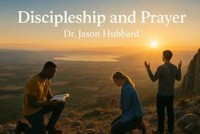
Editorial: ‘Discipleship and Prayer’ - Dr Jason Hubbard
Discipleship and Prayer – by Dr Jason Hubbard
Monday 20th October 2025 will mark our 3rd annual Global Day of Prayer for the Hindu World.
Research tells us that 80 percent of Hindus, Buddhists and Muslims do not know a single Christian. With approximately 1.25 billion Hindus worldwide, Hinduism stands as the third-largest religion globally - with 1 billion of them in India alone!
As Jesus called us to make disciples of all nations, the remaining task before us is massive and it must start with prayer! If the definition of prayer is intimacy with God – the conversational part of the most important love relationship in our lives - then the destination of prayer is the fulfillment of His purposes!
 God has chosen to accomplish His purposes through the prayers of His people. He has ordained prayer as the channel through which He carries out His will.
One of the keys to effective prayer is praying for the fulfillment of the Great Commission!
The Bible places great importance on the role of prayer in the Great Commission. The term "the Great Commission" refers to Jesus' final command to his disciples (and hence to the church as a whole) while He was physically on the earth. We want to pray that every person and family everywhere would have an authentic encounter with the Lord Jesus Christ by the power and presence of the Holy Spirit! And Jesus clearly said that the most effective way to do this - to see the Gospel of the kingdom proclaimed to all the world is by making disciples of every nation!
Jesus commanded his disciples to Go and make disciples of all nations from Mt. Arbel - Arbel is the tallest mountain in Galilee. Matthew’s Gospel tells us that after Jesus’ resurrection, He gave instructions for His disciples to go to the mountain in Galilee.
On a clear day, standing on top of Arbel, you can see for miles. Looking to the north, you can see the peak of Mount Hermon, the largest mountain in Israel, towering over the borders between Lebanon, Syria and Israel. To the east, you can see the Golan Heights, the black, basalt-stoned tabletop range that separates Israel from the countries of Syria and Jordan. Looking to the south, you can see the fertile farmlands of the Jezreel Valley spread out like a patchwork quilt on the floor until it reaches the rolling hills of Samaria. And looking to the west, sits the coastal plain next to the ancient city of Caesarea Maritima, the ancient port city constructed by King Herod where the Apostle Paul set sail to Rome, carrying the Gospel with him to the West.
Jesus was casting a vision - a vision for a global movement of multiplication.
He called his disciples to not just ‘make disciples’ but make disciples that multiply!
Watch this Video! – The Power of Multiplication
 Matthew 28:18-20, “All authority in heaven and on earth has been given to me. Go therefore and make disciples of all nations, baptizing them in the name of the Father and of the Son and of the Holy Spirit, teaching them to observe all that I have commanded you. And behold, I am with you always, to the end of the age”
In this passage, we see first that authority is given to Jesus, and the second part at the end - ‘I am with you always to the end of the age’
 We often focus on the going, on making disciples, on baptizing, or teaching or the mechanics of planting churches - but Jesus’ words start and end with himself - His authority and His presence!
Jesus is the central person and burning core of the great commission - and we connect with Him - His authority and His presence - through prayer!
Prayer is the primary way that God has gifted to us to keep the main thing the main thing - Jesus himself at the center! Jesus has all authority and He is with us - that is the start and finish of the Great Commission!
What is the definition of a Disciple?
The word disciple literally means ‘follower of a master.’ At the time of Christ, a disciple wasn’t simply a learner of a great teacher (rabbi), but he/she was an apprentice or an imitator. Jesus called His first disciples to follow Him and do the things He did and say the things He said!
A simple definition of a disciple would be one who has come to Jesus for eternal life, has claimed Him as Savior and God, and has embarked upon a life of following Him.
A disciple is one who Loves God, loves people, and makes disciples that multiply!
The 3 marks of a Disciple:
 We want to be disciples and make disciples worth reproducing, and according to Jesus, the marks of a disciple are threefold:
- Abides in God’s Word, John 8:31-32
“If you abide in my word, you are truly my disciples, and you will know the truth, and the truth will set you free.”
Prayer is the very lifeblood of a disciple of Jesus! Jesus was clear that Hearing Him – abiding in His word – is the most important aspect to prayer. The word abiding implies remaining in constant fellowship and relationship.
Prayer is the conversational part of the most important love relationship in our lives!
- Loves as Jesus loves, John 13:34-35
“A new commandment I give to you, that you love one another: just as I have loved you, you also are to love one another. By this all people will know that you are my disciples, if you have love for one another.”
One of the first and foremost ways that we love as Jesus loves is by praying for one another! We ask God to do for them what they cannot do for themselves!
- Bears Fruit, John 15:7-8
“If you abide in me, and my words abide in you, ask whatever you wish, and it will be done for you. By this, my Father is glorified, that you bear much fruit and so prove to be my disciples”
According to Jesus, we bear fruit by abiding and asking in prayer. By this, the Father is glorified and we prove to be his disciples.
One of the keys to the fulfillment of the Great Commission is praying to the Lord of the Harvest for laborers to be sent forth!
He said to them, “The harvest truly is great, but the laborers are few; therefore pray the Lord of the harvest to send out laborers into His harvest” (Luke 10:2).
The word for prayer used in this context is deomai, which means desperate prayer! Jesus said the harvest is plentiful but the workers are few – Therefore, Pray – pray fervently, pray with desperation!
As laborers, go forth to proclaim the Gospel of the kingdom, it often comes with resistance. The devil has established spiritual strongholds over peoples, cities and nations. Paul tells us that we have been given weapons of warfare to demolish strongholds and see breakthrough. (2 Cor. 10:4-5).
Power in Praying the Word
One of the most powerful weapons is God’s Word, the Sword of the Spirit. Paul commands us in Ephesians 6 to stand firm, putting on our armor by faith and then wield his word through prayer, praying at all times, for all peoples with all types of prayer (Eph. 6:10-19).
We first pray and declare the supremacy of Jesus over peoples and regions.
Through prayer, we ask the Father to bind and restrain the enemy, the principalities and powers that have blinded the minds of the unbelievers.
We pray for open doors, open heavens, open highways and open hallways for the Gospel to go forth!
We ask the Lord to remove the blindness that the god of this age has placed over the unbelievers that they might see the light of the Gospel in the face of Jesus!
We ask the Father to deliver us from the evil one, just as Jesus came to destroy the works of the devil.
As we offer our worship and praise to the one who sits on the throne and to the Lamb, His presence and light in our midst shatters spiritual darkness, and the power of God delivers families from every faith on earth to become wholehearted followers of Jesus Christ!

We have seen a great surge of worship and intercessory prayer launched in the 90’s through to today!
The Global Prayer Movement has seen remarkable acceleration - the Koreans have contended in early morning prayer for decades, Marches for Jesus took place in streets around the world, the Global Day of Prayer filling stadiums, people prayer walking and praying for breakthrough in gateway cities of the world, the Indonesian prayer tower movement, the passion and fire of Latin and South American prayer meetings, the all night prayer vigils with fasting across the African continent, the travailing prayer movement throughout China, and Spirit-led corporate prayer times across India together with the fresh expression of houses of prayer and worship exploding in the nations, and today over a hundred million believers in united prayer on four global days of prayer each year since 2022!
And during this time, there have been astounding results in missions’ movements around the world -
According to the top missions’ researchers, the disciples and churches in these movements have grown exponentially at an astounding rate of 23 percent annually, much faster than the global population. The total number of disciples in these movements has doubled every 3.5 years - a testimony of the potency of divine multiplication with prayer.
 This global growth has occurred over four distinct stages: **
- From 1995 to 2000 - from 10,000 to over 100,000 disciples
- From 2000 to 2005 - from 100,000 to over 1 million disciples
- From 2005 to 2015 - from 1 million to over 10 million
- From 2015 to 2024 - the number surpassed 100 million
As Christ-exalting, Bible Based, Worship-fed, Spirit-led, Love-motivated prayer is increasing in the nations, more disciples are being made, more churches are being planted, more bibles are being translated, more signs, wonders and miracles are being displayed and more justice is being released to the poor, the marginalized, the orphan and the widow!
So, on the Global Day of Prayer for the Hindu world, let’s lift up our prayers like incense before God who can do immeasurably more than all we ever ask or even imagine for His Glory, for our Joy, and for the multitudes to come to saving knowledge of Jesus throughout the Hindu world!
Dr. Jason Hubbard – Director
International Prayer Connect

DOWNLOAD this article HERE
** Stats as quoted in Forests in the Seed – William J. Dubois, Stan Parks, Justin Long
Israel - ceasefire and hostage deal
After two years of intense conflict, a U.S.-brokered ceasefire between Israel and Hamas has been announced, offering the first real hope for peace in Gaza since 2023. The agreement, reached after marathon talks in Cairo and Washington, includes a phased hostage exchange, humanitarian access, and the withdrawal of Israeli forces from certain areas of the enclave.
According to reports, Hamas will release around 20 hostages in the first 72 hours, while Israel will free several hundred Palestinian detainees, many of whom have been held without trial. The deal also commits both sides to allow vital aid into Gaza under international supervision. Although military analysts remain cautious, leaders worldwide have hailed the agreement as a potential turning point.
For millions of civilians, however, the scars of war remain raw. Gaza’s infrastructure is shattered, with thousands displaced and hospitals overwhelmed. In Israel, families still wait anxiously for news of loved ones. Whether this ceasefire will hold depends on restraint, forgiveness, and sustained international support for rebuilding.
Prayer Pointers
- Pray: for the safe release of all hostages and healing of trauma. “The LORD is close to the brokenhearted.” (Psalm 34:18, NIV)
- Pray: for wise leadership that chooses reconciliation over revenge. “If it is possible… live at peace with everyone.” (Romans 12:18, NIV)
- Pray: for peace to take root in both Israeli and Palestinian hearts. “He makes wars cease to the ends of the earth.” (Psalm 46:9, NIV)
Prayer for Israel and Gaza
Lord, You are our peace. Heal broken families, rebuild ruined homes, and turn hostility into understanding. Let this fragile truce become a foundation for lasting peace in the land You love. Amen.
Ukraine - strikes on energy infrastructure
Ukraine has endured one of the largest overnight bombardments of the war, as Russian forces launched more than 450 Iranian-made drones and 32 missiles across the country. President Volodymyr Zelenskyy said the strikes targeted vital energy facilities, leaving multiple regions temporarily without power and water. In Kyiv, explosions shook neighbourhoods before dawn, while engineers worked through the night to restore electricity and repair substations damaged by falling debris.
Ukraine’s air defences intercepted the majority of incoming drones, yet even a handful that penetrated proved devastating. Several thermal plants and power distribution centres sustained heavy damage, underscoring how Russia continues to weaponize winter by striking civilian infrastructure. Emergency workers battled fires while local churches opened their doors as shelters and distribution points for food, blankets, and prayer.
International condemnation was swift, with European leaders pledging more air-defence systems and humanitarian support. For millions of Ukrainians facing another harsh winter, the attack renewed both fear and resilience - a determination that darkness will not win.
Prayer Pointers
- Pray: for God’s protection over civilians, workers, and responders. “Whoever dwells in the shelter of the Most High will rest in the shadow of the Almighty.” (Psalm 91:1, NIV)
- Pray: for wisdom among world leaders to pursue justice and lasting peace. “He has shown you… what is good: to act justly, love mercy and walk humbly with your God.” (Micah 6:8, NIV)
- Pray: for the Church to shine as a refuge of hope amid the cold and fear. “The name of the LORD is a fortified tower; the righteous run to it and are safe.” (Proverbs 18:10, NIV)
Prayer for Ukraine
Father, shield the weary, warm the cold, and strengthen those who rebuild by candlelight. Let Your light overcome every shadow, and bring an end to this war. Amen.
More: https://news.sky.com/story/russia-used-more-than-450-drones-in-targeted-attack-on-energy-volodymyr-zelenskyy-says-13447902
India — Rajasthan attacks
Reports from Open Doors and local advocacy groups reveal a sharp rise in persecution against Christians in Rajasthan following recent moves toward an anti-conversion law. The proposed legislation mirrors similar laws in a dozen Indian states, which critics say are often misused to intimidate or criminalise ordinary believers for sharing their faith.
In recent months, house churches have been raided, worship services interrupted, and pastors accused of “forced conversions.” Several believers have been detained without charge. Families face social ostracism for attending prayer meetings or owning Bibles. Christian leaders urge believers to remain calm, continue worshipping, and respond with grace rather than fear.
Despite mounting pressure, the Church in Rajasthan continues to grow. Testimonies of answered prayer, miraculous healings, and community service are inspiring many to seek hope in Christ. Yet concerns remain that legal restrictions could embolden extremists and deepen social divides. Indian Christians are calling on the global body of Christ to intercede—for courage, protection, and wisdom in these challenging days.
Prayer Pointers
- Pray: for believers to stand firm and show Christ’s love amid hostility. “Blessed are those who are persecuted because of righteousness, for theirs is the kingdom of heaven.” (Matthew 5:10, NIV)
- Pray: for justice and integrity among lawmakers and police. “The king’s heart is in the hand of the LORD; he directs it like a watercourse wherever he pleases.” (Proverbs 21:1, NIV)
- Pray: for revival and unity within the Indian Church. “Remember those in prison as if you were together with them.” (Hebrews 13:3, NIV)
Prayer for India
Lord Jesus, strengthen Your people in Rajasthan. Fill them with peace that passes understanding and love that disarms fear. May their witness draw many to You. Amen.
More: https://www.opendoorsuk.org/news/latest-news/india-rajasthan-attacks


 “Ask of Me, and I will give You the nations for Your inheritance.” (Psalm 2:8)